


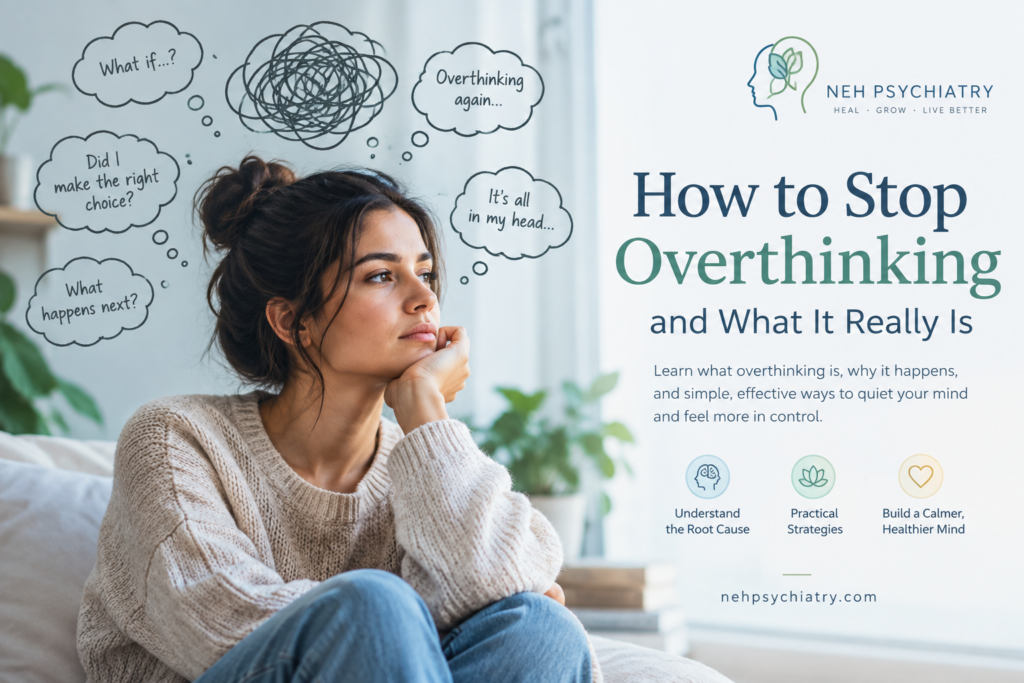
How to Stop Overthinking: A Simple Guide That Actually Works
It’s 1 a.m. and you’re replaying a text you sent three hours ago. Or maybe you’re stuck on one work email, rewriting the same sentence for the tenth time because it “doesn’t sound right” (it sounded fine the first time, by the way). If any of that rings a bell, you already know what overthinking feels like from the inside. You don’t need someone to define it for you. You need a way out of it.
Here’s something worth hearing though: overthinking isn’t a character flaw. It’s a habit your brain fell into, probably years ago, and habits can be unlearned. This isn’t going to be a list of vague affirmations. It’s a real look at why this happens and what actually helps, based on what tends to work for most people, not a magic fix that works for everyone every time.
What Overthinking Actually Is
Overthinking is when your mind keeps circling the same thought without landing anywhere. Normal thinking moves. It weighs things, picks an option, and moves on. Overthinking just loops, often picking up a new “what if” each time it goes around.
There are basically two flavors. Rumination looks backward, replaying something you said or did and hunting for the mistake in it. Worry looks forward, imagining every way tomorrow could go wrong. Most overthinkers do a bit of both, and which one shows up more usually depends on the day, or honestly, on how much sleep you got.
Here’s the annoying part: overthinking feels productive while you’re doing it. It feels like problem solving. It isn’t. Studies on rumination pretty consistently show that circling a problem in your head, without acting on it, tends to make people feel more anxious and stuck, not less. I think that’s the real trap of it. Your brain confuses repetition with progress, and it’s very convincing about it.
Why Your Brain Keeps Doing This
There isn’t one single cause, but a few show up again and again.
Fear of getting it wrong is a big one. If a past decision blew up on you, your brain starts treating every future decision like a live wire. It wants to check things three times before you’re allowed to move.
A need for certainty is another. Some people just find it genuinely hard to sit with “I don’t know yet.” Overthinking becomes a way of trying to force certainty out of a situation that simply doesn’t have any yet, no matter how long you stare at it.
Then there’s perfectionism, the belief that there’s one right answer or one perfect way to phrase something, so you keep hunting for it long after a perfectly good answer already showed up and waved at you.
And plain old exhaustion. Stress and bad sleep make it so much harder to let anything go. Overthinking tends to get worse during your busiest, most tired weeks, not your calm ones, which feels backwards but makes sense once you think about it.
None of this means something’s broken in you. It means your brain learned a pattern, and right now that pattern is running on autopilot, mostly without your permission.
“Okay, So How Do I Actually Stop?”
You can’t just flip a switch and make your brain stop thinking. Nobody can. But you can interrupt the loop before it eats your whole evening.
Name it out loud. The second you catch yourself spiraling, say it, even just in your head: “I’m overthinking this right now.” It sounds almost too simple to work, but that little act of naming pulls you out of autopilot. Psychologists call it cognitive defusion. I just call it useful.
Give yourself a worry window. Pick fifteen or twenty minutes a day, same time, and let yourself worry on purpose during that stretch. Write the thoughts down if that helps. When a worry shows up outside the window, tell it, “not now, you get your turn later.” Most people find that by the time worry hour actually rolls around, the thought’s lost half its punch.
Ask sharper questions. Swap “what if this goes horribly wrong” for “what’s the actual likelihood of that” or “what would I tell a friend going through this.” Overthinking runs on vague, catastrophic questions. Specific ones tend to deflate it fast.
Set yourself a deadline. Five minutes for a small decision. A day for a medium one. A week, tops, for something big. When the timer’s up, you decide with what you’ve got. Waiting for perfect information almost never pays off, mostly because perfect information doesn’t really exist.
Move. Just move. Overthinking lives in your head, so getting into your body tends to snap the loop. A walk around the block, some stretching, even scrubbing a pan, can shift things more than another twenty minutes of “thinking it through” ever will.
Stop rechecking. Rereading the message. Refreshing the thread. Replaying the conversation for the fifth time. All of that feeds the loop, it doesn’t close it. Give yourself one honest look, then walk away. If you catch yourself circling back, that’s your cue to redirect, not to check “just once more.”
Say it out loud to someone. A friend, a voice memo, an empty room, doesn’t matter. Saying a worry out loud forces it into an actual sentence instead of an endless mental loop, and a lot of worries sound a lot smaller once they leave your head and hit the air.
What About the Nighttime Spirals?
Nighttime overthinking plays by its own rules, mostly because you’re exhausted and there’s nothing around to distract you from it.
Keep a notepad by the bed. When a thought pops up, jot it down and tell yourself you’ll deal with it tomorrow. This works better than you’d expect, because your brain often keeps a thought “on” purely out of fear it’ll be forgotten. Writing it down removes that fear.
Skip the phone. Scrolling hands your brain fresh material to spiral about, which is the last thing you need at midnight.
Try slow breathing, four counts in, hold four, six counts out. It’s not about instantly feeling calm, it’s about giving your brain something simple to do besides loop.
A Quick Story, Because This Is Easier to See in Practice
Say you text a friend and six hours pass with no reply. A normal brain thinks, “probably busy, I’ll hear back.” An overthinking brain turns that into a full investigation. Did I say something weird? Should I send a follow up? Are they mad? Should I apologize preemptively just in case? None of those questions have real answers yet, there’s just not enough information, and that gap is exactly what overthinking loves to fill with the worst possible guess. The frustrating thing is you can burn a whole evening on this and end up no closer to actually knowing anything. Just tired and a little embarrassed, honestly.
When It Might Be More Than a Habit
Occasional overthinking is just part of being human. Everyone does it before a big decision, or after an awkward exchange they can’t stop replaying. But if it’s constant, if it’s messing with your sleep, your work, your relationships, most days, not just once in a while, it might be tangled up with anxiety. That’s worth bringing up with a doctor or therapist. Not because something’s wrong with you, but because there are actual tools built for exactly this, cognitive behavioral therapy being one of the more well studied ones.
There’s zero shame in needing more than a checklist here. A pattern that’s been running for years doesn’t always unwind from a blog post, however well meant.
Small Habits That Cut Overthinking Off Before It Starts
Stopping a loop once it’s already spinning takes work. It’s usually easier to lower how often it starts in the first place.
Sleep matters more than people give it credit for. A tired brain has way less capacity to filter out useless, spiraling thoughts.
Ease off caffeine later in the day. It can make your mind race even when there’s nothing specific to be stressed about, which gives a small worry room to snowball into something bigger than it deserves.
Build in real breaks. Overthinking creeps in fastest when you’re mentally maxed out and haven’t given your brain any room to just sit. Five minutes away from a screen, a couple times a day, adds up more than you’d think.
Keep a running list of loose ends. Waiting on an email, a decision, an answer from someone else? Write it down instead of carrying it around in your head all day. That alone gives your brain permission to stop tracking it every five minutes.
The One Thing Worth Remembering
If you forget everything else, hold onto this: overthinking is a loop, and loops need an exit, not a solution. You don’t have to solve the thought sitting in your head. You just need a door out of the room it’s built. Naming it, setting a timer, moving your body, giving yourself a deadline, these are all different doors into the same exit.
It won’t feel natural right away. Old habits rarely do, and honestly some days none of this will work and that’s fine too. But every time you catch the loop and step out of it, you’re teaching your brain a slightly different pattern, and that pattern gets a little stronger each time you use it.